When my three friends and I from Singapore planned our first trip to India, the Himalayas were not originally the main reason for our visit. We chose Rishikesh because it is famous around the world for yoga, spirituality, and the peaceful atmosphere of the Ganges River.
But while planning our trip, I started asking myself another question: if I was already coming to northern India, could I also experience the Himalayas?
I began searching for a short Himalayan trek that could fit into our limited travel schedule. We only had around three to four days available, and none of us were experienced Himalayan trekkers. That is when I discovered the Chopta Trek.
The more I researched, the more interesting it became. The trek offered approximately 30 kilometres of walking over four days, forests, mountain meadows, Deoriatal Lake, Tungnath Temple, Chandrashila Summit, snow, wildlife, and an altitude of around 4,000 metres.
For someone visiting India for the first time, the idea was incredibly exciting.
Reaching approximately 4,000 metres felt like a real Himalayan adventure. It was difficult for me to imagine that within only four days, we could walk through forests, sleep near a mountain lake, experience snow for the first time, watch sunrise from a high Himalayan summit, and explore some of the cultural and spiritual places of Uttarakhand.
At the same time, I was also nervous.
Before coming to India, I had seen many things online that made me worried about hygiene, spicy food, safety, accommodation, scams, and how local people might behave toward foreign travellers.
As a first-time visitor to India, I had many questions.
Would the food be too spicy?
Would the accommodation be clean?
Would trekking in a remote Himalayan region be safe?
Could we trust a local trekking company?
Would we feel comfortable as international travellers?
Four days later, after completing the Chopta Trek in March 2026, my perspective had completely changed.
This article is my honest first-hand experience of travelling from Rishikesh to Chopta with three friends from Singapore, completing my first major Himalayan trek, reaching Chandrashila at around 4,000 metres, experiencing snow trekking for the first time, and discovering a side of India that I had never expected.
If you are an international traveller staying in Rishikesh and looking for a short Himalayan adventure, this is exactly what our experience was like.
Why I Chose the Chopta Trek from Rishikesh
Because it was my first visit to India, I wanted to make the most of the journey.
Rishikesh was already part of our travel plan because of its international reputation for yoga and spirituality. However, after arriving in northern India, I became increasingly interested in seeing the Himalayas.
The challenge was time.
We did not have one or two weeks available for a long expedition. We were looking for something that could fit into approximately three to four days but would still feel like a genuine Himalayan adventure.
While searching online, the Chopta Trek seemed to offer exactly what we wanted.
The experience included:
-
Approximately 30 kilometres of trekking
-
A four-day itinerary
-
Deoriatal Lake
-
Forest trails
-
Open mountain meadows
-
Snow-covered Himalayan views
-
Tungnath Temple
-
Chandrashila Summit
-
An altitude of around 4,000 metres
-
Opportunities to see birds and wildlife
-
Cultural stops during the journey from Rishikesh
What excited me most was the altitude.
For me, reaching around 4,000 metres sounded like a serious adventure. I had never completed a major Himalayan trek before, so the thought of standing at that height and looking at the surrounding mountains was something I really wanted to experience.
At the same time, the trek appeared manageable within our short travel schedule.
That combination made Chopta the right choice for us.
“The idea of reaching around 4,000 metres was extremely exciting for me. It felt like a real Himalayan adventure without needing weeks of trekking experience.”
Looking back now, I believe Chopta was an excellent introduction to Himalayan trekking.
In only four days, we experienced forests, mountain villages, high-altitude trekking, snow, sunrise views, local food, spiritual places, and some of the most beautiful scenery I have ever seen.
My Concerns Before Visiting India for the First Time
I want to be honest about something that many first-time international travellers may also experience.
Before coming to India, I was worried.
Much of the information and videos I had seen online created a negative impression in my mind. I had concerns about several things before arriving.
My main worries were:
-
Food hygiene
-
Very spicy Indian food
-
Clean accommodation
-
Personal safety
-
Possible scams
-
Behaviour of local people toward foreigners
-
Travelling in remote mountain areas
Because this was my first trip to India, I did not know what to expect.
I was particularly concerned about food. I had heard that Indian food could be extremely spicy, and I was unsure how my stomach would react during a high-altitude trekking trip.
I was also worried about hygiene and accommodation. Sleeping in a remote mountain campsite and staying in villages sounded exciting, but I did not know what the actual facilities would be like.
Another major concern was trust.
As an international traveller, choosing a local trekking company for the first time can feel difficult. You are often communicating online, comparing reviews, checking prices, and trying to understand whether the company will actually deliver what it promises.
Fortunately, our actual experience was very different from many of the concerns I had before arriving.
By the end of the trek, my perception of India had changed significantly.
How I Found Mapping the Himalayas
After deciding that we wanted to do a short Himalayan trek from Rishikesh, I started researching online.
I searched for Chopta and different trekking options in Uttarakhand. During my research, I came across Mapping the Himalayas, a local Rishikesh-based trekking company.
Before contacting them, I did what most international travellers probably do.
I researched.
I looked at traveller reviews, checked Tripadvisor, searched Google reviews, and tried to understand what kind of experience previous guests had received.
What caught my attention was the strong feedback from travellers, including many international guests.
I contacted the team, and they responded quickly.
One thing I appreciated was that they did not simply send us a generic response. We discussed our available time and what we wanted from the experience.
Later, while staying in Rishikesh, we also visited their office near the famous Laxman Jhula area.
That visit helped us feel more comfortable.
The team explained the entire itinerary clearly, including the day-by-day schedule, transportation, accommodation, trekking route, food, safety arrangements, and what we should expect during the journey.
What I personally liked most was their attitude.
They were professional, but they were also relaxed, humorous, and passionate about trekking.
I did not feel that their only objective was to finish the trek as quickly as possible.
My impression was that they wanted travellers to actually experience the mountains and create memories.
That was important for us because this was our first major Himalayan trek.
My 4-Day Chopta Trek at a Glance
| Detail | My Experience |
|---|---|
| Trek Duration | 4 Days / 3 Nights |
| Starting Point | Rishikesh |
| Trekking Distance | Approximately 30 km |
| Maximum Altitude | Around 4,000 metres |
| Highest Point | Chandrashila Summit |
| Major Places | Deoriatal, Chopta, Tungnath and Chandrashila |
| Trek Difficulty | Beginner-friendly with proper guidance |
| Travel Month | March 2026 |
| Group Size | 4 friends from Singapore |
| Trek Team | 2 guides and 1 driver |
This was my first major Himalayan trekking experience.
I had not completed any special trekking or fitness training before the trip.
That does not mean preparation is unnecessary for everyone. Every person’s health and fitness level is different. However, based on my personal experience, Chopta felt like an achievable introduction to Himalayan trekking for a beginner with proper support and guidance.
The trek still included long walking days, cold temperatures, snow, steep sections, and high altitude.
For me, that balance made the experience exciting.
Day 1: Rishikesh to Sari Village and My First Trek to Deoriatal
Our adventure began early in the morning.
At around 6 AM, the Mapping the Himalayas team picked us up from our hotel in Rishikesh.
There were four of us, all friends from Singapore, and this was our first trip to India.
Two guides and one driver came to pick us up. Our guides were Ankush and Saurabh.
From the beginning, the team appeared professional and organised.
Although we had already read the itinerary before the trip, the guides explained the plan for Day 1 again so that everyone clearly understood what we would be doing.
Our journey from Rishikesh to Sari Village had begun.
My First Indian Breakfast in Kodiyala
After approximately one hour of driving, we stopped for breakfast in Kodiyala.
This was a memorable moment because it was my first proper experience of Indian food during the journey.
We had aloo paratha with curd.
I was slightly nervous before eating because of my concerns about spicy food, but the meal was simple, delicious, and comfortable to eat.
It was a good beginning to our food experience in India.
After breakfast, we continued our journey deeper into Uttarakhand.
Driving Through the Mountains of Uttarakhand
The drive took us through several important towns and mountain regions, including Devprayag, Srinagar and Rudraprayag.
As we continued travelling, the scenery gradually changed.
The landscape became more mountainous, the roads followed valleys and rivers, and the views became increasingly dramatic.
One of the things I enjoyed about the journey was watching the mountains slowly transform around us.
This was not just transportation from one place to another.
The road journey itself became part of the experience.
After approximately four hours of travelling, we stopped again for lunch.
My First Full Indian Lunch
Lunch was another enjoyable experience.
We ate:
-
Rice
-
Roti
-
Vegies
-
Papad
-
Curd
-
Kadai paneer
For someone who had been worried about Indian food being too spicy, this meal was another positive surprise.
The food was tasty, filling, and comfortable for us.
After lunch, we continued towards Sari Village.
By this stage, the mountain scenery was becoming even more beautiful.
We finally arrived in Sari at approximately 4 PM.
Arriving at Sari Village
Once we arrived, we collected our bags from the vehicle and prepared for the first trekking section of our journey.
Each person carried approximately two litres of water.
Our destination was Deoriatal.
The trek from Sari Village to Deoriatal was approximately 3 kilometres.
For us, it took around one and a half hours.
This was the beginning of my first major Himalayan trekking experience.
The scenery along the route was beautiful, and although this was only the first day, I could already feel that we were entering a completely different environment from the cities we had visited.
My First Night at Deoriatal
We reached Deoriatal at approximately 6 PM.
Our campsite was already prepared for us.
We stayed two people in each tent.
After settling in and refreshing ourselves, we enjoyed black tea.
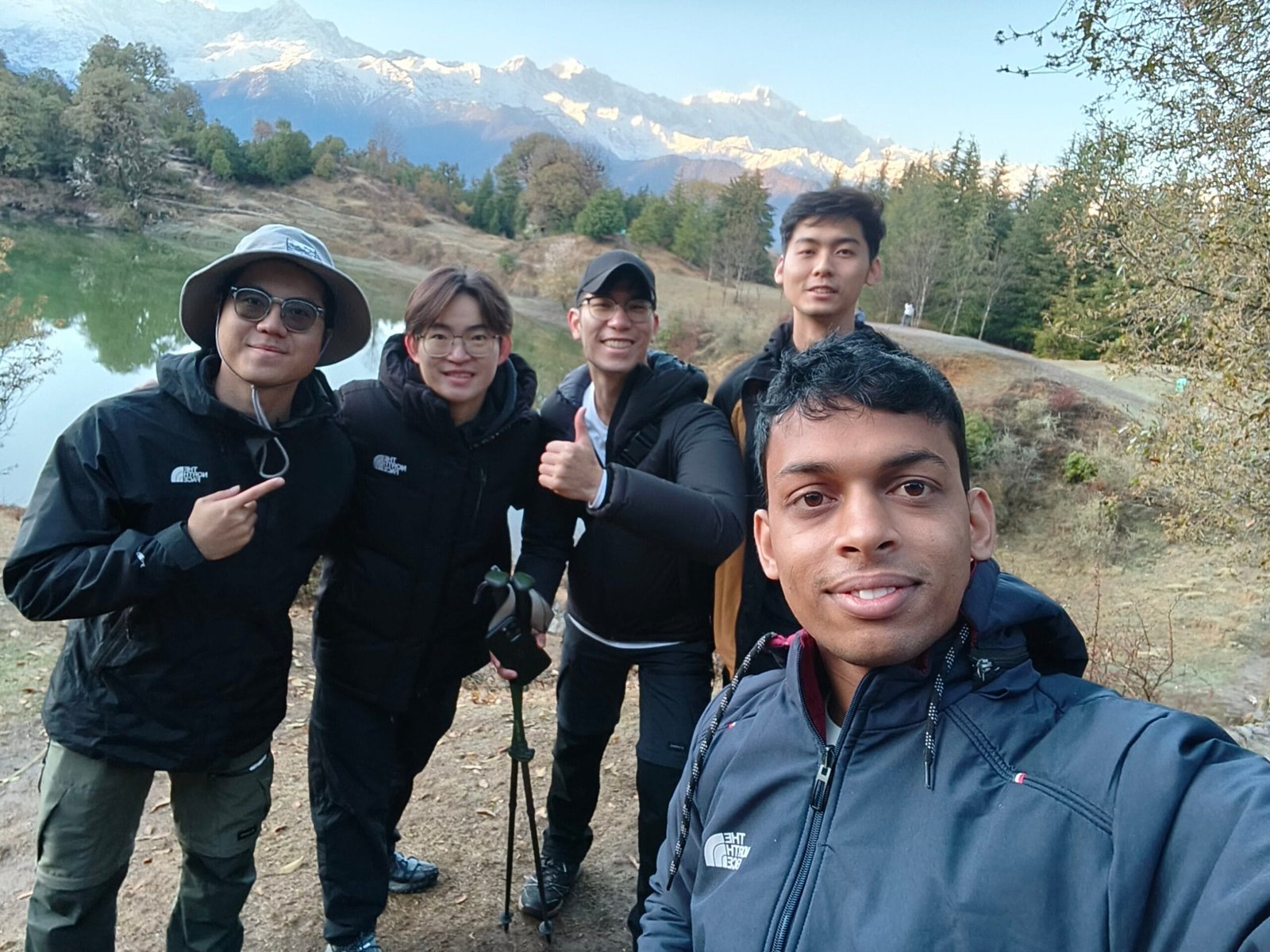
Then we walked toward Deoriatal to see the lake.
This was one of the first truly magical moments of the trip.
The water was incredibly clear, and we could see the reflection of Chaukhamba Peak.
Seeing the mountain reflected in the lake was something I will never forget.
The temperature was cold, and we needed our warm jackets, but the atmosphere made everything worthwhile.
There was something very peaceful about the location.
No traffic.
No city noise.
No busy streets.
Only the mountains, the lake, birds, and the sounds of nature.
“Seeing the crystal-clear reflection of Chaukhamba in Deoriatal felt magical. It was one of the first moments when I realised how beautiful the Himalayas really are.”
After spending time near the lake, we returned to the campsite.
We talked together for a long time, enjoyed the mountain atmosphere, and eventually had a hot dinner.
The food included simple local-style mountain meals, including dal and rice.
Before going to sleep, the guides explained the next day’s activities.
The campsite was extremely quiet.
Far away from any city noise, we could hear birds and other sounds from nature.
It was a completely different experience from everyday life.
And this was only Day 1.
I went to sleep excited about what the next day would bring.
Day 2: Deoriatal to Chopta – My Longest and Most Beautiful Trekking Day
Day 2 became one of my favourite days of the entire journey.
The guides woke us up early in the morning because they wanted us to experience the sunrise over the mountains.
We walked with our guides near Deoriatal and climbed toward a nearby viewpoint. From there, we watched the first light of the day slowly appear over the Himalayan mountains.
Watching sunrise in the mountains was a completely different experience from watching it in a city.
The cold air, silence, changing colours in the sky, and the surrounding peaks created an unforgettable atmosphere.
After watching the sunrise, we walked around Deoriatal before returning to our campsite.
Back at the camp, we enjoyed black tea and had some time to refresh ourselves.
Then we packed our bags and prepared for the longest trekking day of the trip.
Breakfast Before the Longest Trekking Day
Our breakfast included:
-
Poha
-
Papaya
-
Apple
-
Banana
-
Tea
We also collected our packed lunch before starting the trek.
The day’s route was approximately 16 kilometres long, making it the longest trekking day of our four-day journey.
Looking back, I would also say it was one of the most beautiful days.
Starting the 16 km Trek Through the Himalayas
There were only six people walking together that day:
-
Four of us from Singapore
-
Two guides
That made the experience feel very peaceful and personal.
We were not walking in a large tourist group.
As we continued through the mountains, the environment constantly changed.
Sometimes we walked through dense forests.
At other times, the forest opened into wide grassy meadows that almost looked like natural savannah landscapes.
We could hear birds calling from the trees, and the mountain air felt incredibly fresh.
For me, one of the most memorable feelings was simply breathing the cold, clean air while walking through the forest.
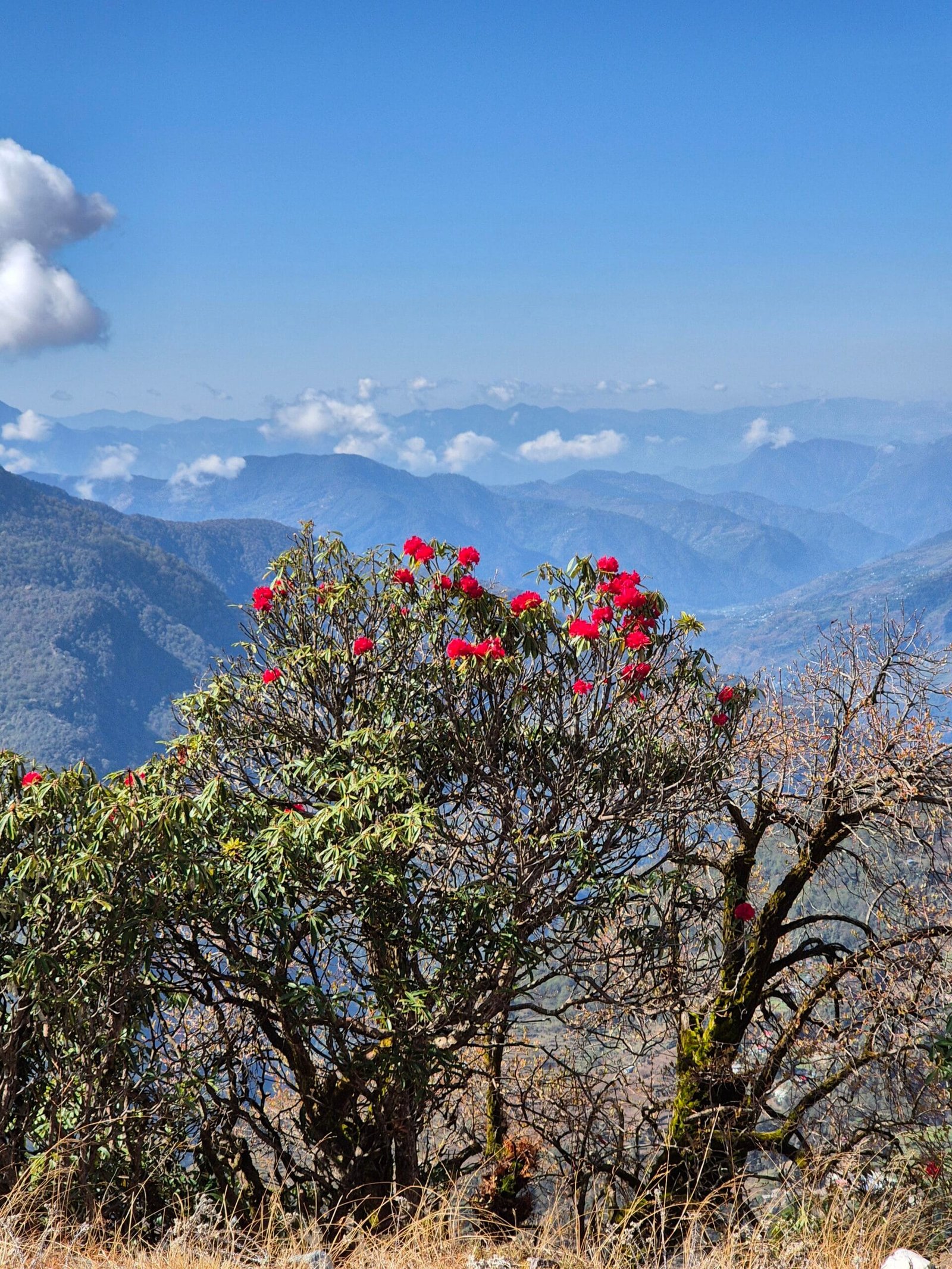
The trail passed through beautiful rhododendron forests, and we could see red flowers among the trees.
At different points, snow-covered Himalayan peaks appeared in the distance.
The combination of forests, open meadows, mountains, birds, and silence made this trekking day feel special.
A Lunch Break with a View of Chaukhamba
At approximately 1 PM, we stopped for lunch.
The location was a beautiful grassy meadow with an excellent view of Chaukhamba Mountain.
It was one of those moments when even an ordinary lunch break became memorable because of the surroundings.
There were also walnut trees in the area.
We found some walnuts beneath one of the trees and tried them.
After lunch, we rested for approximately 15 minutes before continuing the trek.
By this stage, I was beginning to understand why people travel to the Himalayas.
The journey was not only about reaching a destination.
The experience was in every part of the trail.
Crossing a Snow-Fed Mountain Stream
At approximately 3 PM, after walking for around 14 kilometres, we reached a small river or mountain stream.
The water came from melting snow and felt incredibly fresh.
We decided to stop for a while.
We removed our shoes and gave our feet some rest.
After walking such a long distance, even a short break felt very important.
We spent approximately 20 minutes there before continuing.
By now, we knew that the final section of the trek was approaching.
The Final Steep Climb
The last part of the route included a steep climb.
After already walking approximately 14 kilometres, this section felt more challenging.
However, after around one hour, we finally reached the top near the road.
Our vehicle was waiting for us.
It was a satisfying moment.
We had completed approximately 16 kilometres of trekking through forests, meadows, mountain landscapes, and remote Himalayan terrain.
From there, we drove for approximately 10 minutes to our accommodation in Chopta.
Arriving in Chopta
Unlike our first night in tents near Deoriatal, we stayed in rooms at a local homestay in Chopta.
Again, there were two people in each room.
We only had a few minutes to refresh ourselves before tea and pakoras were served.
It was a very enjoyable Indian mountain experience.
Tea and pakoras after a long trekking day tasted especially good.
The altitude in Chopta was approximately 2,700 metres, and the temperature was around 6 degrees Celsius.
Later, we explored the surrounding village and nearby areas.
We enjoyed the peaceful atmosphere and simply spent time experiencing the mountains.
After returning to our rooms, we rested.
At approximately 7 PM, we had dinner.
Once again, the guides explained the next day’s plan.
And this was when we learned that Day 3 would begin much earlier than expected.
We were going to wake up at around 2 AM.
Our destination would be Chandrashila Summit.
And for the first time in my life, I would be trekking through snow.
Day 3: A 2:30 AM Start to Chandrashila Summit at Around 4,000 Metres
Day 3 was the most challenging and unforgettable day of my entire Chopta Trek.
We woke up at approximately 2 AM.
The temperature outside was around -3 degrees Celsius.
For someone from Singapore, this was a completely different world.
The cold felt intense, but we were prepared.
We wore our warm clothes, including jackets and thermal layers, and packed our daypacks.
We also prepared our trekking equipment.
Our gear included:
-
Trekking poles
-
Snow spikes
-
Headlamps
-
Warm gloves
-
Winter clothing
We also carried packed breakfast and black tea in a thermos.
At approximately 2:30 AM, we were ready.
Then we started walking.
Trekking in Complete Darkness
Outside, everything was dark.
The mountains were silent.
There was very little artificial light.
We followed our guides through the darkness using our headlamps.
Occasionally, we could hear birds and other sounds from the surrounding forest.
The area is part of the wider Kedarnath Wildlife Sanctuary landscape, so walking through the mountains in complete darkness felt exciting and slightly mysterious.
However, we felt comfortable because we were with experienced guides who knew the route.
After approximately 500 metres, something changed.
I felt snow beneath my feet.
It was my first time experiencing snow.
For me, this moment was amazing.
Until then, snow had mostly been something I had seen in photographs or videos.
Now I was standing in the Himalayas and walking through it myself.
My First Snow Trekking Experience
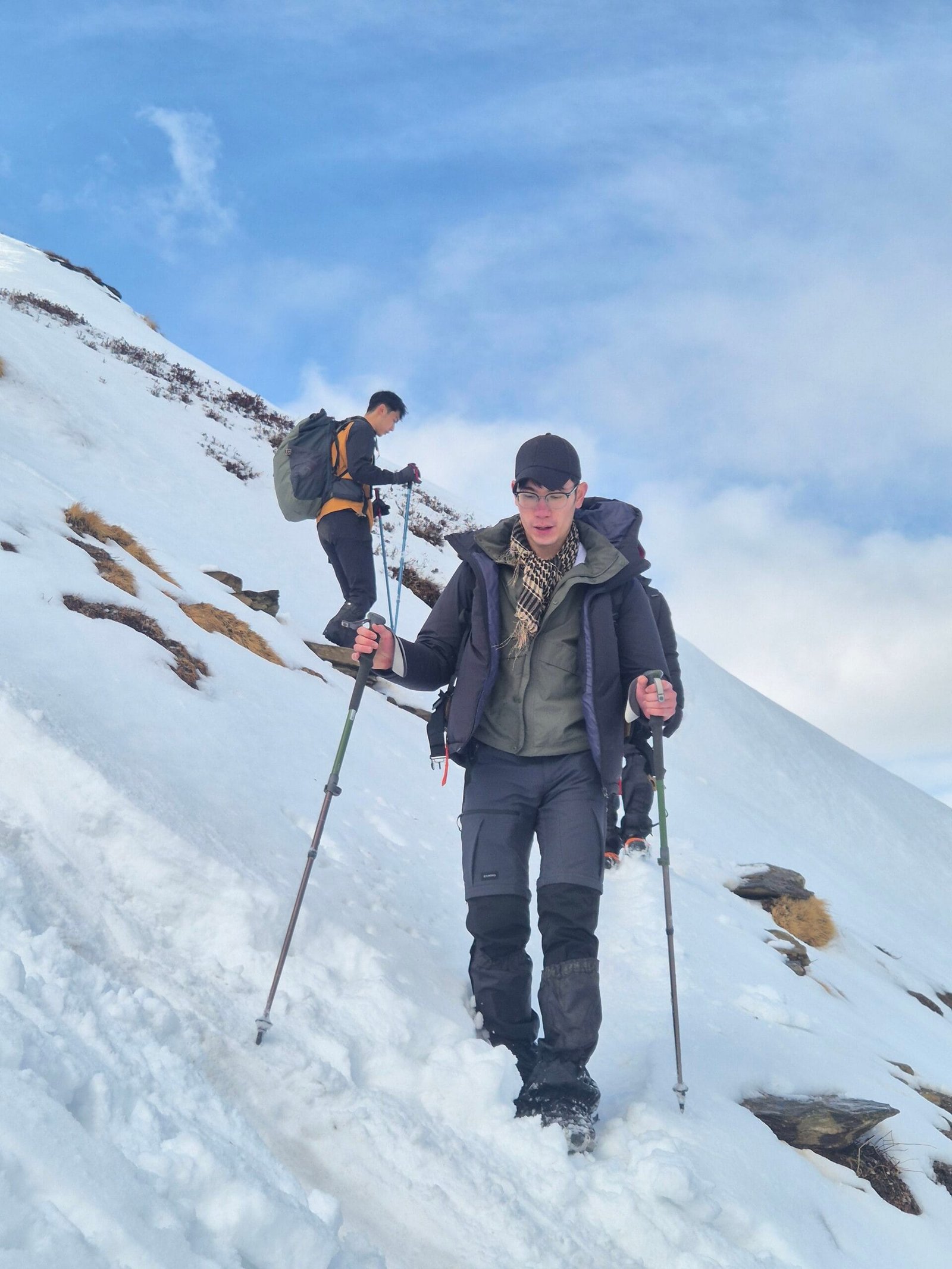
As we continued climbing, the snow became deeper.
At some sections, we were walking through almost one foot of snow.
The route was steep in places, which made the experience more physically demanding.
But at the same time, it was exciting.
This was completely new for me.
I had never experienced snow trekking before.
After approximately two and a half hours of walking, the sky slowly started becoming lighter.
The darkness began to disappear.
The first light before sunrise started appearing over the mountains.
That moment gave us new energy.
We knew we were getting closer to the summit.
The Final Climb to Chandrashila
The final section was physically challenging.
By this point, I was feeling exhausted.
The cold, snow, altitude, and continuous climbing had started affecting my energy.
There was a moment near the end when I honestly felt very tired physically.
I was not sure how much energy I had left.
This was when the guides made a real difference.
They motivated me and used humour to keep the atmosphere positive.
Instead of making the situation feel serious or stressful, they encouraged me to keep moving.
Slowly, step by step, I continued.
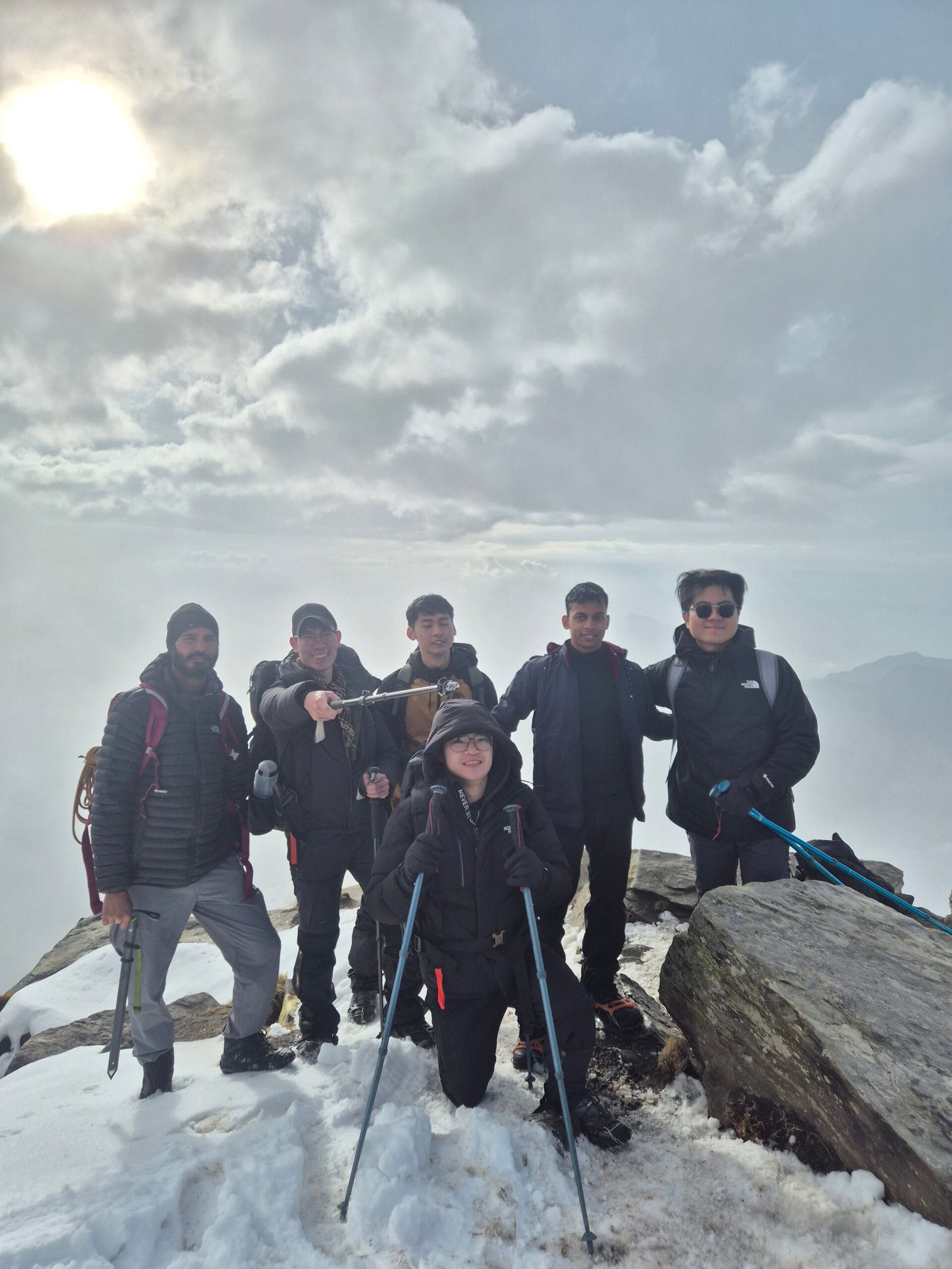
Eventually, we reached Chandrashila Summit.
We were standing at approximately 4,000 metres.
And the view was unbelievable.
Sunrise at Chandrashila Summit
Reaching Chandrashila was one of the most memorable moments of my life.
From the summit, we had an incredible 360-degree view of the surrounding Himalayas.
Snow-covered peaks stretched across the horizon.
We could see famous Himalayan mountains, including views toward peaks such as:
-
Nanda Devi
-
Chaukhamba
-
Hathi-Ghoda
-
Dronagiri
The sunrise slowly appeared over the mountains.
The sky changed colours.
The snow reflected the morning light.
After trekking through darkness and cold for several hours, standing there felt almost unreal.
We took photographs and videos.
Then we opened our packed breakfast.
Breakfast and Hot Tea at Around 4,000 Metres
This was probably my single favourite moment of the entire journey.
We had:
-
Hot black tea
-
Biscuits
-
Aloo paratha
Standing on a Himalayan summit at around 4,000 metres, surrounded by snow-covered mountains, watching the sunrise and drinking hot tea is something I will never forget.
“Having hot tea and breakfast at around 4,000 metres while watching the sunrise over the Himalayas was the most unforgettable moment of my entire trip.”
We spent approximately 45 minutes at the summit.
I wanted to stay longer, but eventually we had to begin our descent.
The mountains were beautiful, but the journey was not over yet.
Walking Down to Tungnath Temple
On our way back, we visited Tungnath Temple.
The temple added another dimension to the journey.
For me, travelling in India was not only about mountains and adventure.
It was also an opportunity to understand local culture, traditions, and faith.
Seeing important spiritual places during the journey helped me understand another side of the Himalayan region.
After visiting Tungnath, we continued descending toward Chopta.
By approximately 10:30 AM, we had reached our accommodation.
After several hours of trekking through snow, hot tea and rest felt wonderful.
We returned to our rooms, relaxed, and later had lunch.
An Evening Exploring the Mountains Around Chopta
In the evening, we went out again to explore the surrounding area.
We saw Himalayan wildlife, including an animal identified to us locally as Himalayan tahr, along with several birds.
We also enjoyed another beautiful mountain sunset.
The contrast between the morning and evening was incredible.
In the morning, we were trekking through darkness and snow at -3°C.
By the evening, we were walking peacefully around the mountain village and watching the sun disappear behind the Himalayas.
After returning to our accommodation, we had dinner.
The guides once again explained the plan for the following day.
Our Himalayan adventure was almost complete.
The next morning, we would begin the long drive back to Rishikesh.
Day 4: Returning to Rishikesh via Dhari Devi and Devprayag
Day 4 was mainly a travel day.
After breakfast, we began our journey back to Rishikesh.
The drive would take approximately eight hours, but it did not feel like a simple return journey.
Our guides included several interesting stops along the way.
Stop at Dhari Devi Temple
One of our stops was at Dhari Devi Temple.
The guides explained the importance of the place and shared information about local beliefs and traditions.
Local people have a strong connection with the temple and its cultural significance.
For me, this was interesting because I was experiencing India as an international visitor.
I was happy not only to see the natural scenery but also to learn about the faith and traditions of the local communities.
Even if you are not travelling primarily for religious reasons, places like this can provide a deeper understanding of the region.
Lunch on the Way Back
Later, we stopped at a restaurant for lunch.
By this point, we were already becoming more comfortable with Indian food.
During the four-day journey, one of my biggest worries had completely disappeared.
The food had been simple, tasty, filling, and not excessively spicy.
I had especially started enjoying tea, Maggi, and aloo paratha with curd.
Visiting Devprayag
Our final major stop was Devprayag.
The guides explained why Devprayag is an important place and why it holds special significance in Hindu culture.
We visited the area near the Sangam and observed local rituals performed by a priest.
It was a meaningful way to finish the journey.
During four days, we had experienced:
-
Forests
-
Mountain villages
-
High-altitude trekking
-
Snow
-
Sunrise from Chandrashila
-
Deoriatal
-
Tungnath
-
Local food
-
Wildlife
-
Cultural traditions
-
Spiritual places
For a trip of only four days, it felt like we had experienced a great deal.
At approximately 4 PM, we finally returned to Rishikesh.
We were dropped back at our hotel, Lemon Tree.
Our Chopta Trek had officially ended.
But the experience stayed with us.
How This Trek Changed My Perception of India
Before coming to India, I was honestly nervous.
As a first-time international traveller, I had many concerns.
I worried about:
-
Hygiene
-
Food
-
Spice levels
-
Safety
-
Scams
-
Accommodation
-
Behaviour of local people
Much of my perception had been influenced by things I had seen online.
I expected India to be much more difficult to navigate.
But after spending time in Rishikesh and completing the Chopta Trek, my perspective changed significantly.
Food and Hygiene Were Better Than I Expected
One of my biggest concerns before arriving was food.
I was worried that everything would be extremely spicy and that I might have difficulty eating during a physically demanding trek.
My experience was completely different.
The food during our journey was simple and tasty.
It was not excessively spicy.
Because the team regularly works with international travellers, they understood that not every guest wants extremely spicy food.
Some of my favourite meals included:
-
Aloo paratha with curd
-
Maggi with tea
-
Poha
-
Rice and dal
-
Paneer dishes
-
Fresh fruit
The meals were suitable for trekking.
They were filling without being unnecessarily complicated.
Drinking Water Was Not a Problem
Another concern for many international travellers visiting India is drinking water.
During our trek, we were provided with filtered and sealed water bottles.
We did not experience any problems.
For me, this removed another major worry.
Clean Accommodation in the Mountains
I was also concerned about accommodation before the trip.
After all, we were travelling into remote Himalayan areas.
However, my experience was positive.
Accommodation at Deoriatal
At Deoriatal, we stayed at a campsite.
Because it was located in a forest environment, the facilities were naturally more basic than a hotel.
However, the campsite was clean.
We stayed two people in each tent.
There was an Indian-style toilet, and the facilities were maintained properly.
Mobile charging was available.
Bathing facilities were limited because of the campsite environment, but hot water could be arranged by speaking with the guides.
For a remote mountain campsite, I found the overall experience very good.
Accommodation in Chopta
In Chopta, we stayed at a homestay.
This was more comfortable than the campsite.
The rooms were clean, and we had:
-
Clean rooms
-
Clean toilets
-
Hot water
-
Electricity
-
Proper bathing facilities
For me, it was an excellent balance between mountain adventure and basic comfort.
The Local People Were One of My Favourite Parts of India
Another thing that surprised me was the behaviour of local people.
Before coming to India, I had worried about how strangers might treat foreign travellers.
But during this journey, my experience was very positive.
The local people I met felt shy, helpful, welcoming, and genuine.
People would greet us with “hello” and “namaste.”
I felt that there was an openness toward visitors.
Of course, one short trip cannot represent an entire country or every person.
However, based on my personal experience in Uttarakhand, the people I met helped make the journey more meaningful.
By the end of the trek, I felt emotional about leaving.
Is the Chopta Trek Good for First-Time International Travellers?
Based on my personal experience, I would say yes.
However, I believe the trekking team you choose is important.
For me, this was my first major Himalayan trek.
I had not completed a serious Himalayan expedition before.
The Chopta Trek gave me an opportunity to experience:
-
High altitude
-
Long-distance trekking
-
Forest trails
-
Snow
-
Mountain weather
-
Camping
-
Village accommodation
-
Himalayan culture
without requiring a long expedition.
I felt that the four-day itinerary offered an excellent introduction to the Himalayas.
The most important factor was having experienced guides who could manage logistics, explain the route, support us during difficult sections, and help us feel comfortable.
How Difficult Is the Chopta Trek for Beginners?
From my personal experience, I found the Chopta Trek beginner-friendly but physically challenging in certain sections.
I did not have major trekking experience before this journey.
However, I was able to complete the trek.
The longest trekking day was approximately 16 kilometres.
The highest point was around 4,000 metres at Chandrashila.
The most difficult part for me was the final climb to the summit.
By that point, I was physically exhausted.
However, the guides motivated me, encouraged me, and kept the atmosphere positive with humour.
That support helped me continue.
| Factor | My Experience |
|---|---|
| Previous Major Trekking Experience | None |
| Special Fitness Training | No |
| Longest Trekking Day | Around 16 km |
| Maximum Altitude | Around 4,000 metres |
| Most Challenging Section | Final climb to Chandrashila |
| Main Challenges | Cold, snow and physical exhaustion |
| Guide Support | Very important |
| Overall Experience | Beginner-friendly with proper guidance |
Every person’s fitness and health condition is different.
I would not suggest that everyone should assume a trek will be easy simply because another traveller completed it.
If you have a medical condition or health concern, you should seek appropriate professional advice before planning a high-altitude trek.
Weather Conditions During My March Chopta Trek
I completed this trek in March 2026.
The weather changed significantly during the four days.
| Day | Weather Experience |
|---|---|
| Day 1 | Sunny |
| Day 2 | Sunny with clouds and light wind |
| Day 3 | Snow and some snowfall |
| Day 4 | Sunny |
Day 3 was the coldest and most dramatic day.
We started trekking at approximately 2:30 AM when the temperature was around -3°C.
Fortunately, we had proper warm jackets, thermal layers, gloves, and other winter equipment.
Because we were prepared, the cold did not create a major problem for us.
What I Actually Packed for the Chopta Trek
I did not carry an unnecessarily large amount of equipment.
The items I personally found useful included:
Clothing
-
Trekking shoes
-
Trekking pants
-
Warm jacket
-
Gloves
-
Two pairs of socks
-
Woollen cap
-
Regular cap
Personal Items
-
Sunglasses
-
Sunscreen
-
High-energy cookies and snacks
Trekking Equipment
Some additional equipment was provided during the trek, including:
-
Trekking poles
-
Snow spikes
-
Other necessary trekking equipment
My advice is to focus on practical clothing that keeps you warm and comfortable.
March conditions can be cold, especially at higher elevations and during early morning trekking.
Mobile Network and Internet During the Trek
If you are planning the Chopta Trek, this is something worth knowing in advance.
From the evening of Day 1 until approximately the evening of Day 2, I had no mobile network.
Once we reached Chopta, Wi-Fi was available, although mobile connectivity remained limited.
For me, this turned out to be a positive experience.
At first, many people might think being without internet is inconvenient.
But during the trek, I actually enjoyed it.
Without constantly checking my phone, I spent more time:
-
Looking at the mountains
-
Talking with my friends
-
Speaking with the guides
-
Enjoying nature
-
Simply being present
For me, the lack of network became a gift.
“Being disconnected from the internet allowed me to connect more with nature and the people around me.”
If you are travelling internationally, I recommend informing your family or friends in advance that mobile connectivity may be limited during parts of the trek.
Safety During the Chopta Trek
Safety was naturally important to me because this was my first major Himalayan trekking experience.
During the trek, the guides carried a first-aid kit.
Fortunately, we did not need to use it.
However, it was reassuring to know that the team was prepared.
The guides also supported us during more difficult sections of the trail.
When the route became challenging, they were attentive and helpful.
During my final climb toward Chandrashila, I became physically exhausted.
Instead of allowing me to become discouraged, the guides motivated me and kept me moving.
Their humour also helped.
That might sound like a small thing, but during a difficult climb, positive energy can make a real difference.
How Much Did My 4-Day Chopta Trek Cost?
I completed the trek in March 2026, so the following price is based on my personal booking and experience.
Prices can change over time, so travellers should always confirm the latest price directly before booking.
My Trek Price
₹15,000 per person
There were four of us.
Total paid: ₹60,000
What Was Included
According to my booking, the package included:
-
Expert Hindi and English-speaking guides
-
Transportation from Rishikesh to Rishikesh
-
4 breakfasts
-
4 lunches
-
3 dinners
-
Morning and evening tea or coffee
-
Entry fees and permissions
-
Trekking poles
-
Snow spikes
-
Accommodation for all three nights during the trek
What Was Not Included
The following were not included:
-
Anything not specifically mentioned in the package
-
Travel or trekking insurance
-
Porter services
-
Horse or mule services
-
Kandi/palanquin services
For the experience we received, I personally felt the overall value was very good.
Why I Chose Mapping the Himalayas for My First Himalayan Trek
Choosing a trekking company was one of the most important decisions for me.
As a first-time visitor to India and a first-time major Himalayan trekker, I wanted to feel comfortable with the people responsible for organising the journey.
My experience with Mapping the Himalayas began before the trek even started.
Fast and Helpful Communication
When I contacted the team, they responded quickly.
We explained that we were international travellers visiting India for the first time and that we were looking for a short Himalayan trek.
They helped us understand the Chopta experience and discussed our requirements.
I appreciated that the communication was clear.
Flexible Booking Experience
I booked the trek approximately one month before the departure date.
One thing that personally increased my trust was the flexibility around payment.
Based on my experience, I was not pressured into making an immediate advance payment.
This made me feel that the company was confident in its service.
Of course, booking policies may change, so future travellers should confirm the current payment terms directly.
Understanding the Needs of International Travellers
For me, this was one of the strongest parts of the experience.
Before coming to India, I was worried about many things that international travellers commonly think about:
-
Food
-
Spice levels
-
Hygiene
-
Accommodation
-
Communication
-
Safety
-
General comfort
During the trek, I felt that the team understood these concerns.
The food was not unnecessarily spicy.
Accommodation was clean.
Water arrangements were handled properly.
The guides communicated clearly.
We did not feel lost or confused about what was happening each day.
Guides Who Became Part of the Experience
Our guides were Ankush and Saurabh.
They were knowledgeable, helpful, informative, and full of humour.
During the trek, they explained the itinerary, the mountains, the route, local areas, and what we should expect.
They also knew when to motivate us.
When I became physically exhausted near Chandrashila, they encouraged me to continue.
Their humour helped make a difficult moment feel more manageable.
By the end of the trek, we had developed an emotional connection with the guides.
For me, they did not feel like people who were simply doing a job and waiting for the trek to finish.
They genuinely seemed passionate about the mountains and about giving travellers a memorable experience.
“They felt less like strangers and more like people who already understood what we needed as first-time visitors to India.”
Support Beyond the Trek
Another thing I appreciated was that their support did not feel limited only to the trekking days.
While staying in Rishikesh, I felt that they were also willing to help us when needed.
For a first-time visitor to India, having trustworthy local people available can make a significant difference.
If I had to describe my experience with Mapping the Himalayas in one sentence, I would say:
“They understand what international travellers may need in India, and they combine professionalism with trust, familiarity, safety and humour.”
My 5 Most Memorable Moments from the Chopta Trek
1. The Chaukhamba Reflection at Deoriatal
Seeing Chaukhamba Peak reflected in the clear water of Deoriatal was magical.
It was peaceful, quiet, and completely different from anything I had experienced before.
This was one of my favourite photography locations during the entire trip.
2. Walking Through Forests and Open Meadows
Day 2 was probably my favourite full trekking day.
Walking through dense forests, listening to birds, passing through rhododendron trees, and then suddenly entering open grassy landscapes was an incredible experience.
The scenery constantly changed.
3. My First Snow Trekking Experience
Until this trip, I had never walked through snow.
Feeling snow under my feet for the first time in the darkness of the Himalayas was exciting.
Later, walking through deeper snow made the experience even more memorable.
4. Sunrise and Breakfast at Chandrashila
This was the highlight of the entire journey.
Starting at 2:30 AM in -3°C temperatures, walking through darkness and snow, reaching approximately 4,000 metres, and finally watching sunrise over the Himalayas was unforgettable.
Drinking hot tea and eating breakfast on the summit made it even more special.
5. Being Without Mobile Internet
I never expected the lack of mobile network to become one of my favourite parts of the trek.
But without internet, we spent more time talking, laughing, walking, and enjoying nature.
Sometimes disconnecting from the digital world allows you to experience the real world more deeply.
Why I Would Recommend Chopta to International Travellers
If an international traveller told me:
“I only have three or four days free in India, and I am staying in Rishikesh. Should I consider Chopta?”
My answer would be yes.
The main reason is the amount of experience you can have in a short time.
Within approximately four days, you can experience:
-
The Himalayas
-
High-altitude trekking
-
Around 30 kilometres of walking
-
Forest trails
-
Mountain meadows
-
Deoriatal Lake
-
Snow during winter conditions
-
Sunrise and sunset in the mountains
-
Chandrashila Summit
-
Tungnath Temple
-
Devprayag
-
Dhari Devi
-
Local food
-
Local culture
-
Wildlife and birdlife
For me, Chopta offered a complete Himalayan introduction within a relatively short travel schedule.
Frequently Asked Questions About the Chopta Trek from Rishikesh
Is the Chopta Trek suitable for beginners?
Based on my personal experience, yes. This was my first major Himalayan trek, and I was able to complete it without previous major trekking experience. However, there are long walking days, steep sections, cold weather and high altitude. Individual fitness and health conditions vary, so travellers should prepare appropriately and seek professional advice if they have medical concerns.
How many days are required for the Chopta Trek from Rishikesh?
My experience was completed over 4 days and 3 nights. This included travel from Rishikesh, trekking to Deoriatal, a long forest trek toward Chopta, the Chandrashila summit trek, and the return journey to Rishikesh.
What is the highest altitude on the Chopta Trek?
During my trek, the highest point was Chandrashila Summit at approximately 4,000 metres.
Can international travellers do the Chopta Trek?
Yes. Based on my experience as a first-time visitor to India from Singapore, the trek can be suitable for international travellers with proper planning and a reliable local support team.
Is snow available during the Chopta Trek?
It depends on the season and weather conditions. I completed the trek in March 2026 and experienced snow and some snowfall during the Chandrashila trekking day.
What should I pack for the Chopta Trek?
I personally used trekking shoes, trekking pants, a warm jacket, gloves, woollen cap, regular cap, socks, sunglasses, sunscreen and high-energy snacks. Winter conditions require appropriate warm clothing.
Is mobile network available during the trek?
During my experience, there was no mobile network from the evening of Day 1 until approximately the evening of Day 2. Wi-Fi was available after reaching Chopta, although mobile connectivity remained limited.
Is the food very spicy?
The food during my trek was not excessively spicy. The meals were simple, tasty and comfortable for us as international travellers. However, food preparation can vary, so travellers with specific dietary requirements should communicate them before the trip.
How much does the Chopta Trek cost?
My March 2026 package cost ₹15,000 per person. Prices can change, so travellers should confirm the latest cost and inclusions directly before booking.
Do I need previous trekking experience?
I personally did not have major Himalayan trekking experience before completing this trek. However, previous experience, fitness and health requirements can vary depending on the individual and current conditions.
Is accommodation available during the trek?
During my experience, we stayed at a campsite near Deoriatal for one night and in a homestay in Chopta for the following nights.
Is the Chopta Trek safe?
Safety depends on weather conditions, individual preparation, route conditions and the trekking team. During my experience, our guides carried a first-aid kit, provided equipment where needed and supported us during difficult sections.
My Final Verdict: 10/10 for My First Himalayan Trek
If I had to rate my Chopta Trek experience, I would give it: 10/10
The reason is simple.
I never felt stressed about managing the logistics.
Transportation, accommodation, food, equipment and the daily plan were organised for us.
Every day brought something new.
On Day 1, we experienced our first Himalayan mountain lake.
On Day 2, we walked through forests and open meadows.
On Day 3, we trekked through snow in the darkness and watched sunrise from approximately 4,000 metres.
On Day 4, we travelled through the mountains and explored cultural and spiritual places before returning to Rishikesh.
Every morning, I was excited to discover what would happen next.
“Everything was planned without giving us tension. Every day brought a new surprise, and we were always excited to discover what would come next.”
But the biggest change was personal.
Before coming to India, I was nervous.
After completing this trek, I felt much more confident.
The experience made me believe that with the right preparation and professional support, much bigger Himalayan adventures could become possible in the future.
In fact, after this experience, I became interested in booking a more challenging high-altitude trek.
That is probably the best proof of how much this journey changed me.
Final Thoughts: My First Major Himalayan Trek in India
The Chopta Trek was much more than a trekking holiday for me.
It was my first major Himalayan experience.
It was also my first visit to India.
I arrived with concerns about hygiene, food, safety, accommodation, scams and travelling in an unfamiliar country.
I left with memories of mountains, forests, snow, local food, friendly people, sunrise, laughter and meaningful connections.
The reflection of Chaukhamba in Deoriatal.
The sound of birds in the forest.
Walking through snow for the first time.
Feeling exhausted near Chandrashila but continuing with encouragement from my guides.
Drinking hot tea at approximately 4,000 metres.
Watching sunrise surrounded by Himalayan peaks.
These are memories I will carry with me for a long time.
I also left India with a completely different perspective from the one I had before arriving.
Sometimes, the best journeys are not only about discovering a new place.
They are also about changing the way you see the world.
For me, Chopta did exactly that.
If you are visiting Rishikesh and have only a few days available, but still want a genuine Himalayan experience, I believe the Chopta Trek is an incredible option.
It gave me my first real experience of the Himalayas.
And it made me want to come back for more.
Ready to Experience the Chopta Trek?
If you are staying in Rishikesh and looking for a short Himalayan adventure, the Chopta Trek can offer forests, mountain lakes, high-altitude trekking, snow, sunrise views, local culture and some of the most spectacular scenery in Uttarakhand.
For first-time visitors to India, having experienced local support can also make the journey more comfortable and enjoyable.
Explore the Chopta Trek and start planning your own Himalayan adventure.
About This Experience
This article is based on the first-hand experience of four travellers from Singapore who completed a 4-day Chopta Trek in March 2026 during their first visit to India.
The experiences, opinions and observations described in this article are personal. Weather conditions, prices, accommodation, route conditions and services may change over time.